
The Great Serengeti Wildebeest Migration is not a solitary once-a-year spectacle, nor is it a stampede that operates on a fixed railway timetable. Instead, it is an unending, circular pilgrimage spanning over 1,800 miles across the ancient volcanic plains of Tanzania and into the rolling hills of the Maasai Mara. At any given moment, roughly 1.5 million blue wildebeest, accompanied by 300,000 zebra and half a million gazelles, are in perpetual motion, dictated purely by rain, phosphate-rich shoots, and instinctive memory.
For safari travelers planning an expedition for 2025 or 2026, the question is not simply “when does it happen?”, but rather “which act of the drama do you wish to bear witness to?” Understanding the spatial ecology of the Serengeti allows you to position yourself precisely where the dramatic tensions of life and survival unfold.
Migration Timing At-A-Glance
If your calendar is rigid, match your arrival window to these three defining chapters of the Serengeti cycle:
Calving Season
Southern Serengeti & Ndutu. 8,000 births daily, intense big cat interactions.
The Rut & Grumeti
Central Seronera to Western Corridor. Mega-herds column up; dramatic territorial sparring.
Mara River Crossings
Kogatende & Northern Serengeti. Heart-stopping Nile crocodile confrontations.
December to March: The Calving Season on the Ndutu Plains
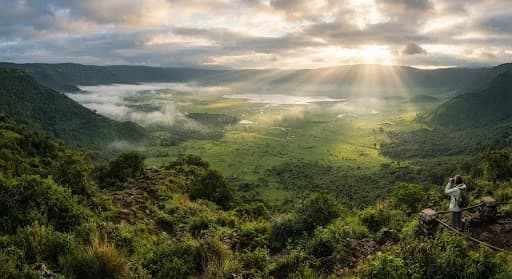
Following the short rains of November, the herds funnel southward into the nutrient-dense short-grass plains flanking the Ngorongoro Conservation Area and Ndutu. The soils here, enriched by volcanic ash blown from Ol Doinyo Lengai over centuries, produce grass brimming with phosphorus, potassium, and calcium—vital minerals for lactating cows.
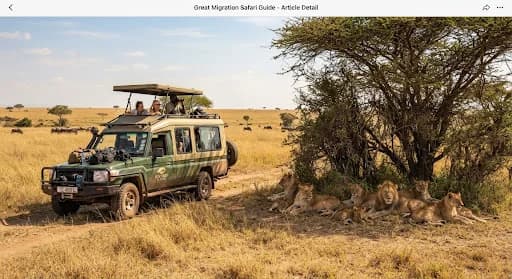
Between late January and mid-February, nature coordinates one of the animal kingdom’s most astonishing synchronizations: roughly 8,000 wildebeest calves are birthed every single day over a three-week window. A calf learns to stand and sprint within three to seven minutes of emergence. This survival haste is urgent; the southern plains host the densest concentration of apex predators on earth. Lion prides stake out acacia copses, cheetah coalitions utilize low termite mounds for high-speed intercept vectors, and spotted hyenas patrol the peripheries relentlessly.
Master Guide Insight: Ndutu Off-Road Permitting
Unlike Serengeti National Park proper, Ndutu falls within the Ngorongoro Conservation Area buffer zone, granting certified local operators off-road driving privileges. This allows Asili Explorer 4x4s to track predator hunts respectfully without being chained to designated trails.
April to June: The Clamorous Rut & Grumeti River Obstacle
As moisture retreats from the southern plains in April, the grasses dry into golden stubble. The herds coalesce into elongated, multi-mile columns that snake northwest toward Lake Victoria through the Moru Kopjes and into the Western Corridor. May welcomes the frenzied rut: over half a million bulls establish micro-territories, grunting rhythmically in a deafening chorus known to local Maasai as nyumbu.
By June, the vanguard meets its first major barrier: the Grumeti River. Although narrower than the Mara, the Grumeti’s slow-flowing channels and dense riverine forests conceal monstrous Nile crocodiles, some exceeding sixteen feet in length. It provides an intimate, dramatic wildlife encounter with significantly lighter vehicle counts than the peak northern crossings.
July to October: The Northern Serengeti & Mara River Crossings
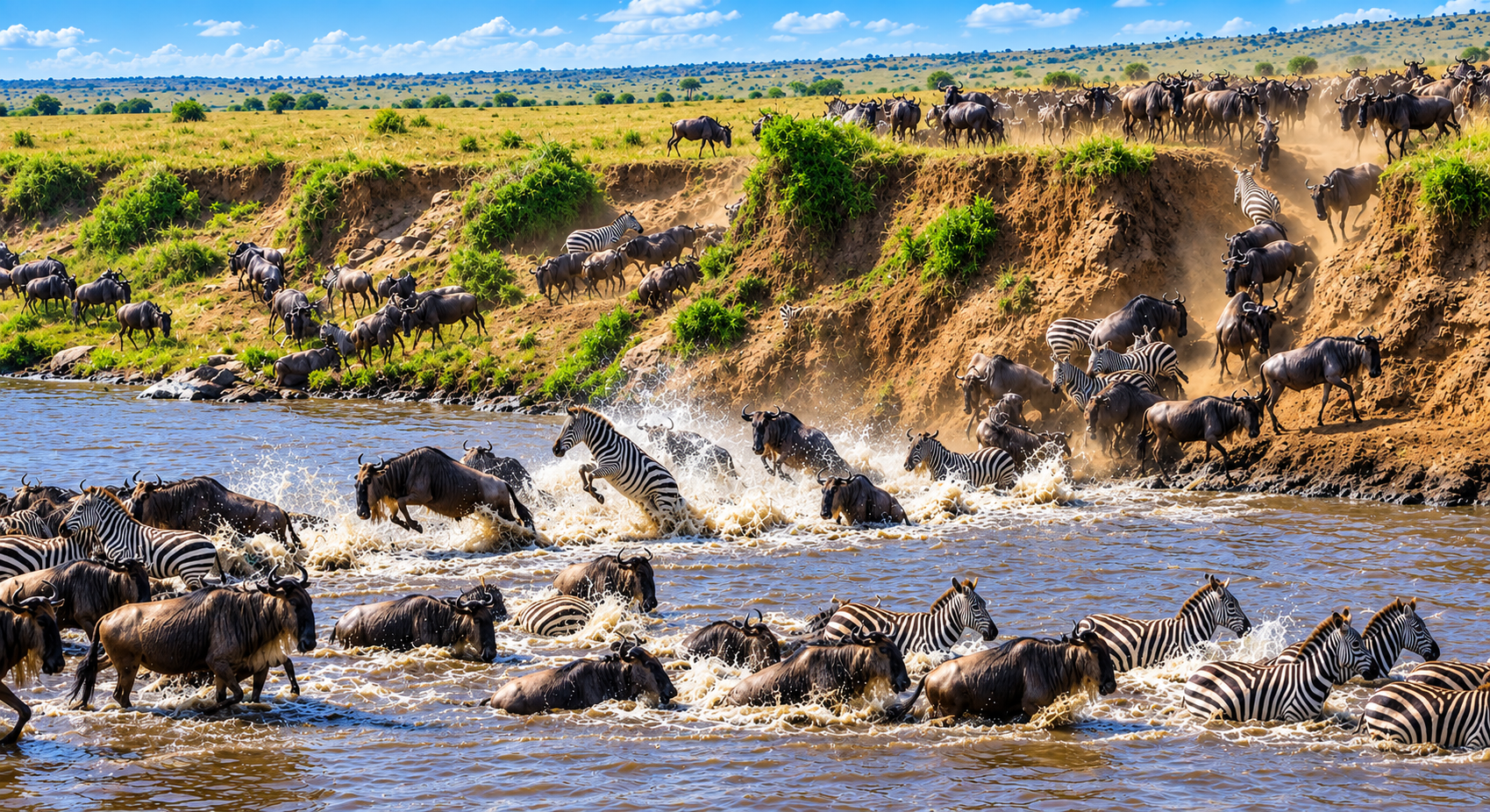
This is the zenith of the safari calendar. By July, the masses gather on the rolling ridges above Kogatende and the Mara River. The crossing is not a scripted spectacle; herds may congregate on steep cliffs for hours—or days—snorting and building collective momentum until a single courageous zebra or wildebeest leaps into the turbulent brown torrent.
Once initiated, hundreds follow in a cascading torrent of hooves and churning foam. Crocodiles converge rapidly, while downstream rapids pose an equally fatal threat. Surviving herds graze peacefully upon the northern grasslands until brief rains in late October nudge them south once more, closing the 365-day loop.
Comprehensive Month-by-Month Planning Matrix
A tactical field reference formulated by Asili Explorer’s Arusha head guide desk.
| Month | Ecosystem Region | Primary Wildlife Action | Recommended Lodges / Mobile Camps |
|---|---|---|---|
| Jan – Mar | Southern Serengeti / Ndutu | Peak calving; cheetah & lion predatory chases; nursery herds. | Lake Ndutu Luxury Tented Lodge, Asili Signature Mobile Ndutu |
| Apr – May | Central Seronera & Moru Kopjes | Massive rutting activity; black rhino tracking in rocky kopjes. | Dunia Camp, Kubu Kubu Tented Lodge |
| Jun – Jul | Western Corridor & Grumeti | Grumeti river crossing attempts; giant crocs; colossal migration columns. | Mbalageti Serengeti, Singita Faru Faru |
| Aug – Oct | Northern Serengeti (Kogatende) | Dramatic Mara river crossings; leopard encounters along riverbeds. | Sayari Camp, Asili Mara Explorer Under Canvas |
| Nov – Dec | Eastern Lobo & Seronera South | Return trek southwards; lush green landscapes after short rains. | Lemala Ewanjan, Melia Serengeti Lodge |
Practical Field Tips from Master Naturalist Juma
Minimum 4 Nights in One Sector
River crossings cannot be rushed. Spending fewer than 3-4 nights in Kogatende reduces your crossing sighting probabilities significantly.
Lens Focal Length Advice
Pack a 100-400mm or 150-600mm zoom. Crossings require swift focal variation from expansive river panoramas to tight crocodile action frames.
Sidestepping Bottlenecks
Crossings #4 through #8 along the upper Mara feature dramatic steep ravines with only a fraction of the commercial vehicle volume.

Juma Macha
Lead SpecialistJuma has spearheaded over 140 bespoke Serengeti wilderness expeditions across 18+ years. A certified FGASA Level 3 Master Naturalist born on the slopes of Mount Meru, he is renowned across East Africa for his intuitive understanding of animal acoustic alerts and predator movement behaviors.